Improved Apriori Algorithm
Improved Apriori Algorithm
Section titled “Improved Apriori Algorithm”Overview
Section titled “Overview”The Improved Apriori algorithm (also known as the Weighted Apriori Algorithm) is an optimized version of the traditional Apriori algorithm that eliminates repeated database scans by using intersection-based counting. The key innovation is calculating support for candidate itemsets by intersecting the support transactions of their K-order subsets, ensuring the database is scanned only once.
Key Innovation: Single Database Scan
Section titled “Key Innovation: Single Database Scan”The primary enhancement involves calculating the support of candidate itemsets $C_k$ based on the support transactions of their K-order subsets. This ensures the database is scanned only once, dramatically improving efficiency compared to the traditional Apriori algorithm.
Analogy: Instead of checking the entire country (database) every time a new address (candidate itemset) is generated, the algorithm cross-references existing delivery records (K-support transactions) to confirm the new address is valid, completing the task much faster.
Algorithm Description
Section titled “Algorithm Description”- DB: Transactional Database
- wminsup: Minimum Weighted Support
Output
Section titled “Output”- F: The complete set of frequent patterns
Method
Section titled “Method”-
Initial Scan and $L_1$ Generation (Single Database Scan Phase)
- Scan DB once to find initial support transactions for all items
- Generate candidate 1-itemsets ($C_1$)
- Filter $C_1$ to find $L_1$ based on minimum weighted support
-
Iterative Generation and Pruning
- While $L_{k-1}$ is not empty:
- Generate candidate k-itemsets $C_k$ from $L_{k-1}$ using
apriori_gen - Calculate support for candidates by intersecting K-order subset support transactions
- Filter $C_k$ to find frequent k-itemsets $L_k$
- Update the total frequent set $F$ and increment $k$
- Generate candidate k-itemsets $C_k$ from $L_{k-1}$ using
- While $L_{k-1}$ is not empty:
-
Return $F$
Core Optimization: Intersection-Based Counting
Section titled “Core Optimization: Intersection-Based Counting”The algorithm’s key optimization is in Step 4, where the count of a candidate itemset $C$ is found by determining the intersection of support transactions in all K-order subset support affairs. This process makes it equivalent to finding the support $K+1$ without needing to re-scan the source database multiple times.
How It Works
Section titled “How It Works”For a candidate k-itemset $C$:
- Generate all (k-1)-subsets of $C$
- Retrieve the support transactions (transaction IDs) for each (k-1)-subset
- Compute the intersection of all these support transaction sets
- The size of the intersection gives the support count for $C$
Example:
- For candidate itemset {A, B, C}:
- Find support transactions for {A, B}
- Find support transactions for {A, C}
- Find support transactions for {B, C}
- Intersect all three sets
- The intersection size = support count for {A, B, C}
Pseudocode
Section titled “Pseudocode”Main Algorithm
Section titled “Main Algorithm”// 1. Scan DB once to find initial support transactions and C1Scan DB;Locate item_sup_trans; // Locate support transactions for all itemsC1 = Generate_C1(DB); // Generate Candidate 1-itemsets
// 2. Filter C1 to find L1 based on minimum weighted support (wminsup)L1 = locate_frequent_1_itemset; // Find L1 based on initial countsF = {}; // Initialize the final set of frequent itemsetsk = 2; // Start iteration for L2
// Loop until no more frequent itemsets are foundWhile L_{k-1} is not empty { // 3. Generate Candidate k-itemsets Ck from L_{k-1} CK = apriori_gen(L_{k-1});
// 4. Calculate support for candidates Ck by intersecting K-support transactions For all candidate itemset C ∈ CK { C.suptrans = SCk;
// Find intersection of support transactions for all K-order subsets S of C While descending power subset S { C.suptrans = C.suptrans ∩ S.suptrans; }
// C.count is determined by the size of the resulting intersection set C.count = |C.suptrans|; }
// 5. Filter Ck to find frequent k-itemsets Lk based on weighted support L_k = {c ∈ C_k | C.count ≥ wminsup};
// 6. Update the total frequent set F and increment k F = F ∪ L_k; k = k + 1;}
Return F;Function: apriori_gen
Section titled “Function: apriori_gen”Function apriori_gen (L_{k-1}) { CK = {}; // Initialize candidate set Ck
// Join Step For all itemset g1, g2 ∈ L_{k-1} do { if ( (g1_1 = g2_1) ^ (g1_{k-2} = g2_{k-2}) ^ (g1_{k-1} < g2_{k-1}) ) then { C = {g1_1, g1_2, ..., g1_{k-1}, g2_{k-1}}; add C to CK; } }
// Pruning Step For all C ∈ CK do { For all (K-1) itemset X ⊂ C do { if (X ∉ L_{k-1}) then { delete C from CK; } } }
Return CK;}Implementation Structure
Section titled “Implementation Structure”The ImprovedApriori class provides a complete implementation:
from improved_apriori import ImprovedApriori
model = ImprovedApriori(    min_support=0.01,      # Minimum weighted support threshold    min_confidence=0.5    # Minimum confidence threshold)
model.fit(transactions)model.generate_association_rules()
# Get resultsfrequent_itemsets = model.get_frequent_itemsets()association_rules = model.get_association_rules()runtime_stats = model.get_runtime_stats()
Key Features
Section titled “Key Features”1. Single Database Scan
Section titled “1. Single Database Scan”- Scans the database once to find support transactions for all items
- Stores transaction IDs where each item appears
- Eliminates repeated database scans
2. Intersection-Based Counting
Section titled “2. Intersection-Based Counting”- Calculates support by intersecting (k-1)-subset support transactions
- No need to rescan database for candidate itemsets
- Efficient set operations for support calculation
3. Support Transaction Storage
Section titled “3. Support Transaction Storage”- Maintains a dictionary mapping itemsets to their support transaction sets
- Enables efficient intersection operations
- Supports association rule generation without database rescanning
4. Runtime Metrics
Section titled “4. Runtime Metrics”- Comprehensive runtime tracking:
fit_time: Total time for fit() methodfrequent_itemsets_time: Time to find frequent itemsetsassociation_rules_time: Time to generate association rulesinitial_scan_time: Time for initial database scancandidate_generation_time: Total time for candidate generationsupport_calculation_time: Total time for support calculation via intersection
Performance Advantages
Section titled “Performance Advantages”Compared to traditional Apriori:
-
Reduced Database Scans
- Traditional Apriori: Scans database once per iteration (k scans)
- Improved Apriori: Scans database only once (1 scan)
-
Efficient Support Calculation
- Traditional Apriori: Scans entire database for each candidate
- Improved Apriori: Uses set intersection operations on stored transaction IDs
-
Memory Efficiency
- Stores transaction IDs (integers) instead of full transaction data
- Set intersection operations are highly optimized in Python
-
Scalability
- Performance improvement increases with dataset size
- Set operations scale better than database scans
Complexity Analysis
Section titled “Complexity Analysis”-
Time Complexity:
- Database scan: O(n × m) where n = transactions, m = average items per transaction
- Candidate generation: O(|L_{k-1}|²) for join step
- Support calculation: O(k × |C_k| × avg_support_trans_size) using intersections
- Overall: Better than traditional Apriori due to single scan
-
Space Complexity:
- Support transactions storage: O(|F| × avg_support_size)
- Frequent itemsets: O(|F|)
- Similar to traditional Apriori
Comparison with Other Algorithms
Section titled “Comparison with Other Algorithms”vs. Traditional Apriori
Section titled “vs. Traditional Apriori”- ✅ Single database scan vs. multiple scans
- ✅ Faster support calculation via intersection
- ✅ Same correctness - produces identical results
- ✅ Better runtime metrics for detailed analysis
vs. FP-Growth
Section titled “vs. FP-Growth”- ✅ Maintains Apriori’s interpretability - candidate generation is explicit
- ✅ No tree construction overhead - simpler data structures
- ⚠️ Still generates candidates (though more efficiently)
- ⚠️ May generate more candidates than FP-Growth’s pattern growth approach
Current Status
Section titled “Current Status”The improved Apriori algorithm is:
- ✅ Fully implemented with intersection-based counting
- ✅ Comprehensive runtime tracking for performance analysis
- ✅ Complete association rule generation using stored support transactions
- ✅ Well-documented with detailed docstrings and comments
- ✅ Production-ready for use in frequent itemset mining
Usage Example
Section titled “Usage Example”from improved_apriori import ImprovedApriori
# Prepare transactionstransactions = [ ['bread', 'milk'], ['bread', 'diaper', 'beer', 'eggs'], ['milk', 'diaper', 'beer', 'cola'], ['bread', 'milk', 'diaper', 'beer'], ['bread', 'milk', 'diaper', 'cola']]
# Initialize and run algorithmmodel = ImprovedApriori(min_support=0.6, min_confidence=0.5)model.fit(transactions)model.generate_association_rules()
# Get resultsfrequent_itemsets = model.get_frequent_itemsets()association_rules = model.get_association_rules()runtime_stats = model.get_runtime_stats()
# Display resultsprint("Frequent Itemsets:")for size, itemsets in frequent_itemsets.items(): print(f"{size}-itemsets: {len(itemsets)}")
print(f"\nAssociation Rules: {len(association_rules)}")print(f"\nRuntime Statistics:")for metric, value in runtime_stats.items(): print(f" {metric}: {value:.4f}s")Experimental Results
Section titled “Experimental Results”Our implementation includes comprehensive runtime tracking and visualization. See the Results page for detailed performance analysis and comparison with Traditional Apriori and FP-Growth.
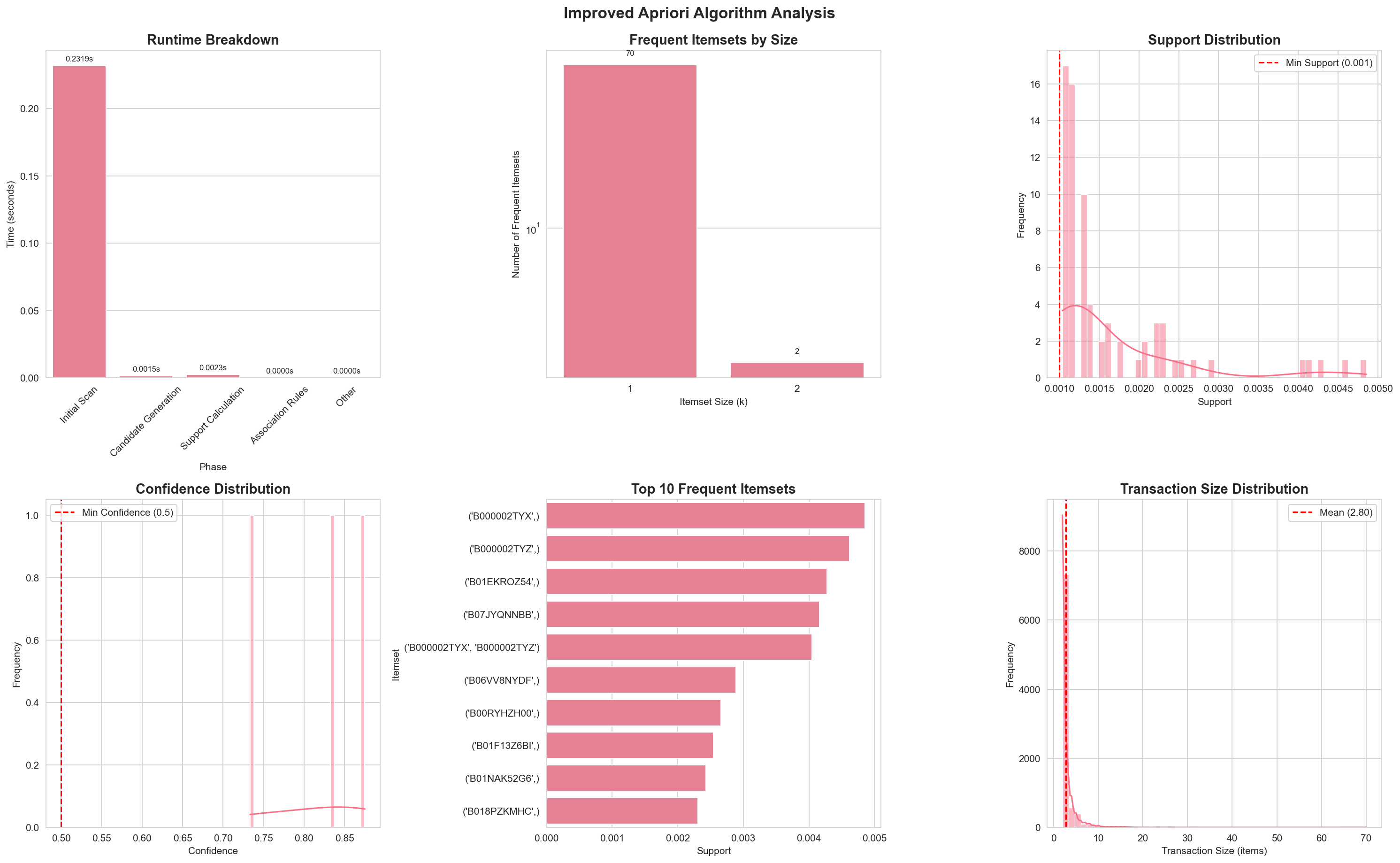
Complete analysis visualization showing detailed runtime breakdown (initial scan, candidate generation, support calculation), frequent itemsets by size, support and confidence distributions, top itemsets, and transaction size distribution.
The Improved Apriori algorithm demonstrates:
- ~10x speedup over traditional Apriori through single database scan optimization
- Identical results to traditional Apriori, validating correctness
- Detailed runtime metrics showing the effectiveness of intersection-based counting
- Consistent performance across different support thresholds
Related Algorithms
Section titled “Related Algorithms”- Traditional Apriori Algorithm - Standard implementation with multiple database scans
- FP-Growth Algorithm - Tree-based approach avoiding candidate generation